# The Most Important Thing You Don't Know About Promises
Take a look at the below code:
```
const promise = new Promise((resolve, reject) => {
resolve();
});
promise
.then(() => {
console.log('first');
})
.then(() => {
console.log('second');
})
.then(() => {
console.log('third');
})
.catch((error) => {
console.log('error', error);
});
```
If you execute the above code, you'll see the following output:
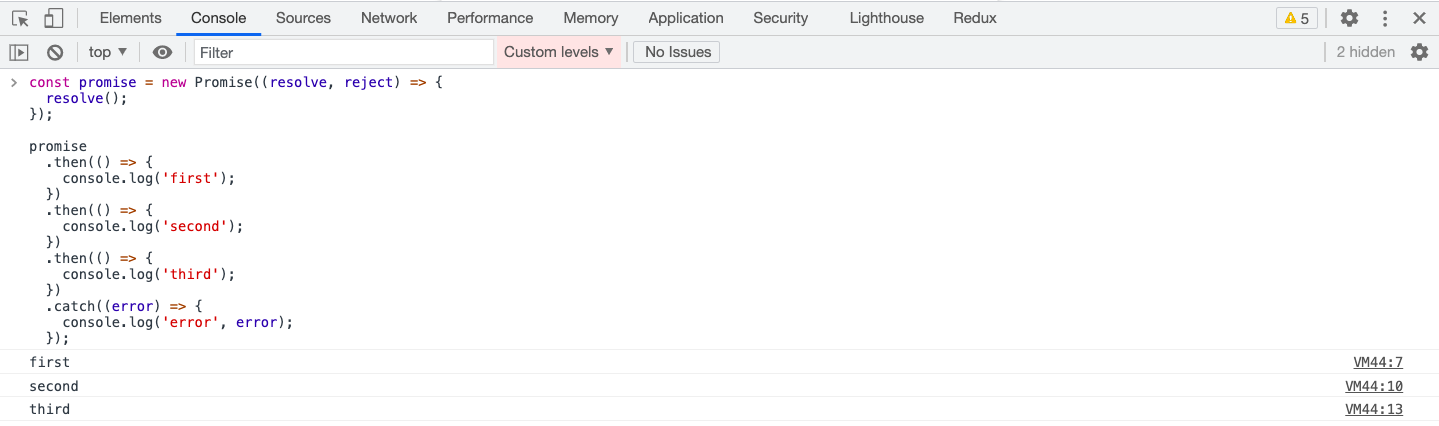
As you know each `.then` handler will be executed one after the another and the value returned from the previous `.then` handler is passed to the next `.then` handler so we get the output of the above code as:
```
first
second
third
```
which is as expected.
But now, take a look at the below code:
```
const promise = new Promise((resolve, reject) => {
resolve();
});
promise
.then(() => {
console.log('first');
})
.then(() => {
setTimeout(() => {
console.log('second');
}, 2000);
})
.then(() => {
setTimeout(() => {
console.log('third');
}, 1000);
});
```
If you execute the above code you will see the following output:
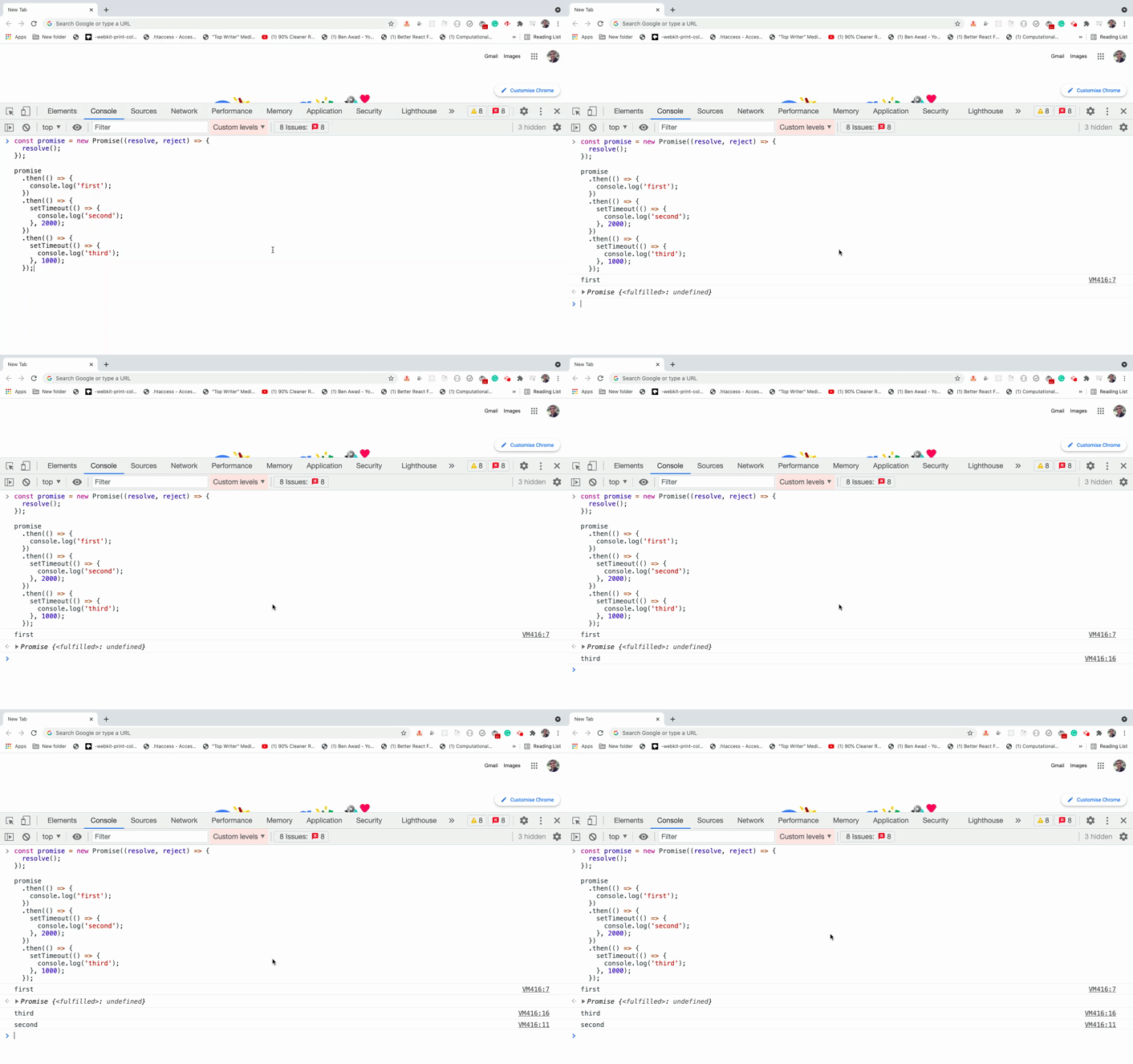
We're getting the output as:
```
first
third
second
```
In the above code, the second `.then` handler has a setTimeout function call with 2000 milliseconds(2 seconds) as the timeout so it will not be executed immediately, but the third `.then` will be executed before the second `.then` handler as it has a 1000 millisecond(1 second) timeout.
Therefore, we're seeing `first` printed immediately and after 1 second, `third` will be printed and after 2 seconds `second` will be printed.
**So If any `.then` handler is making an API call or doing some long-running operation then the next `.then` handler function might be executed immediately even If the long-running operation in the previous `.then` handler is not completed yet.**
> When you attach multiple `.then` handlers, it’s not guaranteed that the next `.then` handler will be called only after the previous `.then` handler finishes if there is additional asynchronous code inside the handler.
**There is a way to fix this default behavior.**
We can return a new promise from the second `.then` handler and only call `resolve` or `reject` once we are done with our API call or any other long-running operation.
This will guarantee that the next `.then` will always be executed after the previous one has finished.
This is because when we call a promise, the Promise will wait until we explicitly call `resolve` or `reject` inside the promise.
The following is the code that will maintain the order sequence:
```
const promise = new Promise((resolve, reject) => {
resolve();
});
promise
.then(() => {
console.log('first');
})
.then(() => {
return new Promise((resolve, reject) => {
setTimeout(() => {
console.log('second');
resolve();
}, 2000);
});
})
.then(() => {
setTimeout(() => {
console.log('third');
}, 1000);
});
```
As you can see, we're returning a promise from the second `.then` handler so the next `.then` handler will be executed only if the second `.then` handler resolves.
If you execute the above code you will see the following output:
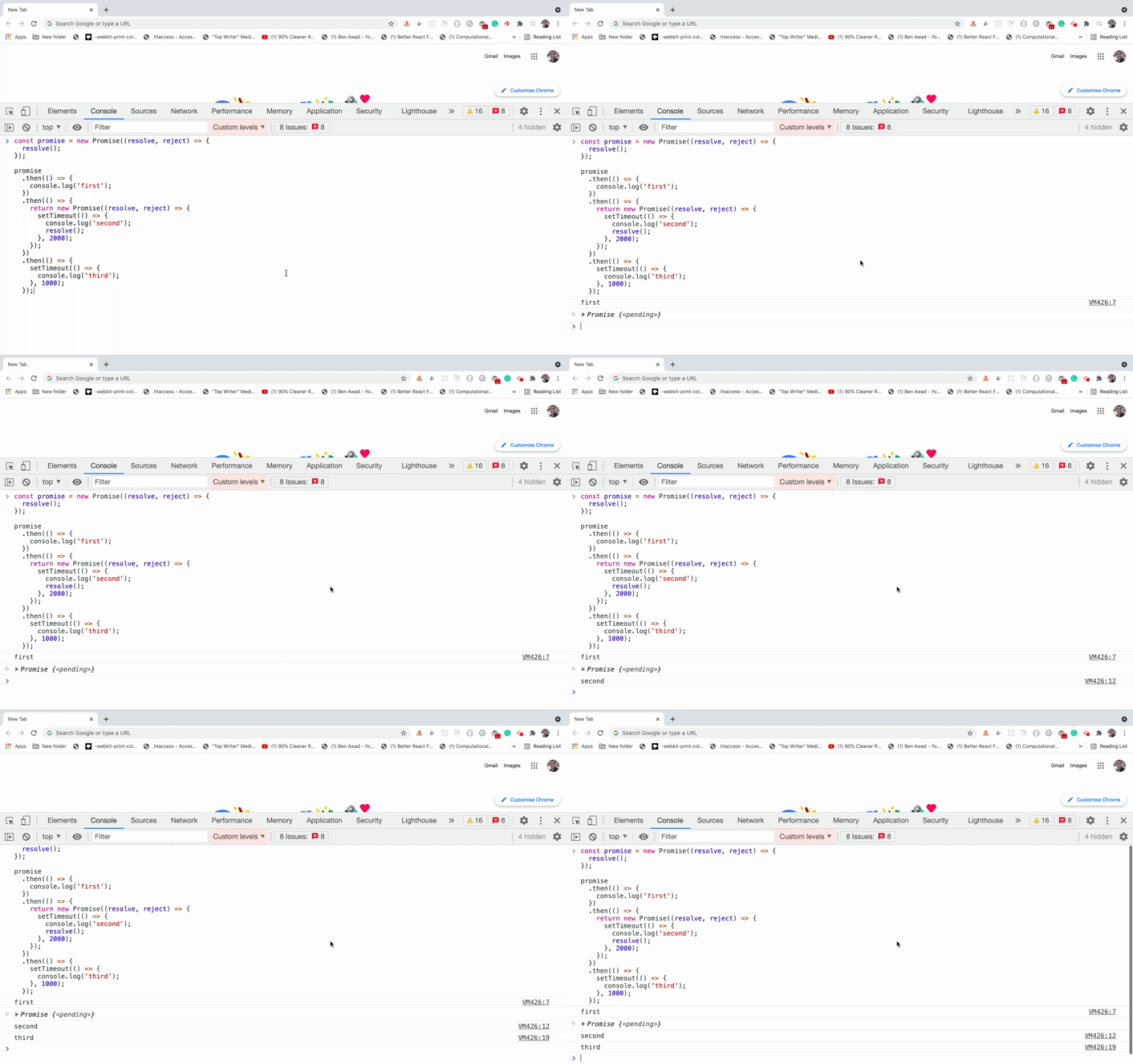
As you can see now, each `.then` handle is executed only after the previous one is finished executed.
That's it about this article.
### Thanks for reading!
Check out my recently published [Mastering Redux](https://master-redux.yogeshchavan.dev/) course.
In this course, you will learn:
* Basic and advanced Redux
* How to manage the complex state of array and objects
* How to use multiple reducers to manage complex redux state
* How to debug Redux application
* How to use Redux in React using react-redux library to make your app reactive.
* How to use redux-thunk library to handle async API calls and much more
and then finally we'll build a complete [food ordering app](https://www.youtube.com/watch?v=2zaPDfCKAvM) from scratch with stripe integration for accepting payments and deploy it to the production.
[ ](https://bit.ly/3w0DGum)
**Want to stay up to date with regular content regarding JavaScript, React, Node.js? [Follow me on LinkedIn](https://www.linkedin.com/in/yogesh-chavan97/).**
[
](https://bit.ly/3w0DGum)
**Want to stay up to date with regular content regarding JavaScript, React, Node.js? [Follow me on LinkedIn](https://www.linkedin.com/in/yogesh-chavan97/).**
[ ](https://www.buymeacoffee.com/myogeshchavan97)